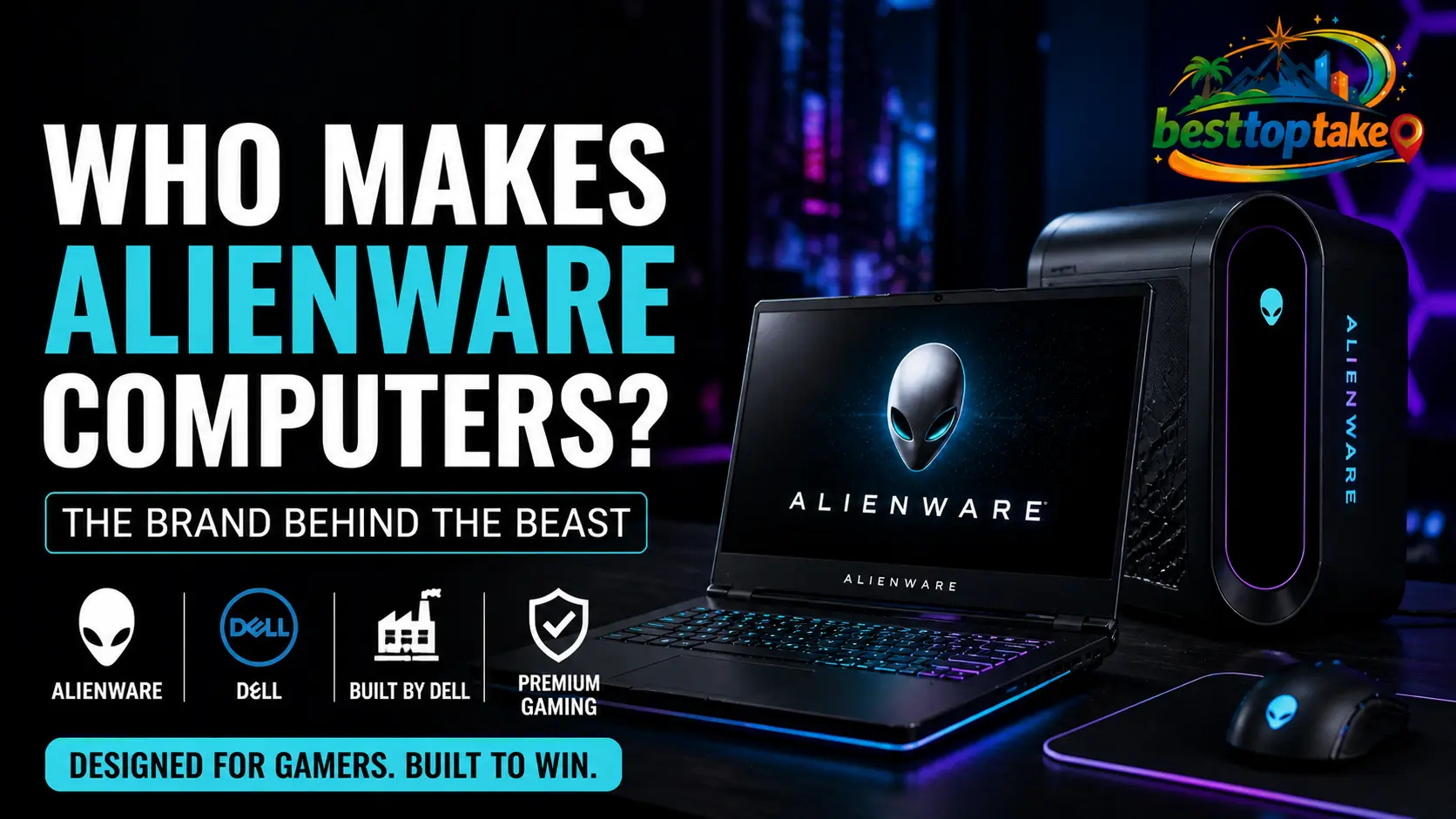
Alienware computers are made by Dell Technologies. Dell acquired Alienware in 2006, and today it operates as a wholly owned subsidiary, keeping its own design team, brand identity, and gaming focus while benefiting from Dell’s massive global resources.
You Thought Alienware Was Independent, Didn’t You?
If you’ve ever stared at one of those glowing alien-head logos and assumed some scrappy startup was behind it — I get it. I felt the same way the first time I dug into the brand’s history. Alienware feels too cool, too niche, too gaming to belong to a corporate giant.
But the truth is layered and actually pretty fascinating. Alienware does have rebellious roots. And understanding who makes Alienware computers today helps you make smarter buying decisions — whether you’re in the US, UK, Canada, or Australia, and whether you’re spending $1,500 or $5,000 on a gaming rig.
In this article, I’ll walk you through the full story: where Alienware came from, who owns it now, how that affects the quality of the machines, and whether this brand is still worth your money in 2026.
The 3 Biggest Questions Buyers Have About Alienware’s Ownership
Before we get into the history, let me address the real concerns I see people raise again and again in forums and buyer communities.
Problem 1: “Is Alienware just a rebadged Dell?”
This is the most common worry. People fear that since Dell owns Alienware, the machines are simply Dell computers with a fancy alien sticker slapped on them.
Why this concern exists: Dell does use its own supply chain and manufacturing partners for Alienware hardware. Some internal components — like certain motherboard designs and chassis manufacturing — are shared or influenced by Dell’s infrastructure.
The practical reality: Alienware retains its own product development team, its own design language, and its own software ecosystem (AlienFX lighting, Alienware Command Center). The thermal designs, chassis engineering, and gaming-specific tuning are done independently. An Alienware Aurora desktop does not look, feel, or perform like a standard Dell XPS. They are distinct products built with different priorities.
Problem 2: “Did Dell ruin Alienware after the acquisition?”
Some long-time Alienware fans from the early 2000s grumble that the brand lost its soul after Dell took over. This is worth addressing honestly.
Why this happens: Before 2006, Alienware was a scrappy, independent company building custom gaming machines by hand in Miami. There was a cult following. Post-acquisition, some of that artisan feel faded.
What actually changed: Alienware scaled up massively. It gained access to Dell’s global distribution, meaning you can now buy Alienware in Australia through Dell’s retail partners, in the UK through Currys and Dell.com, in Canada through Best Buy and Dell directly, and across the USA in major retailers. Pricing became more competitive. The product line expanded significantly.
What didn’t change: the brand identity, the gaming focus, and — critically — the founders stayed on to run the company for years after the deal. Dell’s own spokesperson said at the time of acquisition, “We certainly don’t plan to go in there and really change anything because we recognize that they’re successful and why they’re still successful.”
Problem 3: “Is Alienware still worth the premium price in 2026?”
This one’s the most personal. Alienware machines are not cheap. In the US and Australia, flagship models regularly push past $3,000–$4,000 AUD or USD. UK buyers will find similarly steep prices in GBP. Is it justified?
The honest answer: It depends on what you value. If you want top-tier out-of-box performance, strong warranty support, and a premium aesthetic without having to build your own PC — Alienware justifies the cost. If you’re technically capable and cost-conscious, a custom-built rig will usually beat Alienware on price-per-frame.
According to a 2026 analysis by PCMobileGames, Alienware systems sit roughly 15–25% higher in initial cost compared to an equivalent DIY build, but they come with Dell’s premium on-site service options and factory-tested reliability.
The Origin Story: Two Friends in Miami
Let’s go back to where this all started.
In 1996, two childhood friends Nelson Gonzalez and Alex Aguila founded a company originally called Saikai of Miami, Inc. They were assembling custom desktop computers for local businesses in South Florida. Pretty humble beginnings.
Their pivot came when they noticed a gap in the market: hardcore PC gamers had money to spend and nowhere to spend it intelligently. The mainstream brands weren’t building machines optimised for gaming. Gonzalez and Aguila saw their opportunity.
They rebranded as Alienware, leaned hard into a sci-fi aesthetic, and began building high-performance gaming PCs by hand with top-shelf components. The alien-themed branding — the glowing eyes, the otherworldly chassis — wasn’t just marketing. It was a statement that these machines were different.
By the early 2000s, Alienware had a devoted following, particularly among PC gamers in the USA. The brand was growing fast, but it was limited by capital. Expanding globally, investing in R&D, and competing with larger manufacturers required resources the founders didn’t have on their own.
Dell Steps In: The 2006 Acquisition
Dell had been watching Alienware since at least 2002. The world’s largest PC manufacturer was looking to break into the premium gaming market. Dell had already launched its XPS line in 2001, but Alienware had something Dell didn’t: street cred with gamers.
On March 22, 2006, Dell officially announced it was acquiring Alienware. The deal closed on May 8, 2006. The purchase price was never publicly disclosed.
The terms were unusually favourable for Alienware’s identity. Dell confirmed that Alienware would maintain its own product development, marketing, sales, technical support, and other operations, as well as its brand — with the current management and founders continuing to operate the company as a wholly owned subsidiary.
This wasn’t a typical acquisition where the smaller brand gets absorbed. Nelson Gonzalez described the deal in practical terms: access to Dell’s distribution system and the benefits of a well-resourced parent company, without losing control.
As a subsidiary of Dell, Alienware retains control of its design and marketing while benefiting from Dell’s purchasing power, economies of scale, and supply chain, which lowered its operating costs.
For buyers in the UK, Canada, and Australia, this meant Alienware products finally became available through proper retail channels. Before the acquisition, getting an Alienware machine outside the USA was either expensive or complicated.
What Dell Ownership Actually Means for Your Machine
Here’s what changes — and what doesn’t — when a brand is acquired by a tech giant.
What Dell brought to the table:
- Global distribution networks, making Alienware accessible in over 180 countries
- Manufacturing scale that kept component costs lower than they would have been independently
- A customer support infrastructure with on-site service options
- R&D investment that accelerated new product development
- Stability — Alienware could plan long-term without worrying about cash flow
What Alienware kept for itself:
- Its own design team creating the distinctive chassis aesthetics
- The AlienFX RGB lighting system and Alienware Command Center software
- Gaming-specific thermal and cooling engineering
- Brand positioning squarely in the premium gaming segment
- A product roadmap independent from Dell’s mainstream lineup
Alienware has a long, storied history of crafting excellent gaming laptops, even before it joined Dell and began benefiting from that company’s expertise,” wrote Zachary Boddy, Staff Writer at Windows Central, noting the brand’s continued strength in 2024.
This balance — independent design within a well-resourced corporate structure — is why Alienware continues to be taken seriously by serious gamers.
Alienware’s Product Line in 2026: What They Actually Make
Knowing who makes Alienware computers is one thing. Knowing what they make is equally useful.
Desktops
The flagship is the Alienware Aurora line. The Aurora R16 (and R17 in newer iterations) features a redesigned tower with improved airflow, RTX 40/50-series NVIDIA GPUs, up to Intel Core i9 or AMD Ryzen processors, and the signature AlienFX RGB lighting.
These machines are available directly from Dell.com in the USA, UK, Canada, and Australia, as well as through major retailers like Best Buy (US/Canada) and Currys (UK).
Laptops
Alienware’s laptop lineup is split into two clear tiers:
- The Area-51 series — the top tier. The Alienware 16 and 18 Area-51 models run from RTX 5070 Ti up to RTX 5090 with Intel Core Ultra 9 processors, with prices starting at $3,099.99 for the cheapest model. These are desktop-replacement machines.
- The Aurora series — more accessible entry points into the Alienware ecosystem, starting from RTX 4050 configurations.
Peripherals
Alienware also manufactures gaming monitors, keyboards, mice, and headsets under the same brand. These are designed to match the aesthetic of their PC lineup and integrate with the AlienFX lighting ecosystem.
Is Alienware Right for You?
“Alienware is well-known for its distinctive design language and reputation for premium products, and that still holds true today,” according to Zachary Boddy of Windows Central, reviewing the full 2024/2025 Alienware lineup.
That reputation didn’t come from nowhere. But it also doesn’t mean Alienware is automatically the best choice for every buyer.
Alienware makes sense if:
- You want a premium, factory-tested gaming machine without building it yourself
- Warranty support and on-site service matter to you (useful for buyers in regional areas of Australia or Canada where local repair shops are scarce)
- You value brand reputation and aesthetics alongside raw performance
- You’re buying for a content creation or streaming setup and want reliability over maximum DIY flexibility
Consider alternatives if:
- You’re comfortable building your own PC and want maximum value per dollar (or pound, or AUD)
- You need maximum upgrade flexibility — Alienware’s cases can be limiting
- Budget is your primary constraint
The Australian Competition and Consumer Commission (ACCC) provides guidance on consumer electronics warranties that’s worth reading if you’re in Australia and weighing up premium tech purchases — understanding your statutory rights can be just as important as choosing the right brand.
Gaming Industry Expert Perspective
“The gaming PC market has matured to the point where brand trust and support infrastructure are as important to buyers as raw specs. Alienware understood this early.” — Dr. Jon Peddie, President of Jon Peddie Research, a leading analyst firm covering the graphics and gaming PC industry.
For non-technical buyers — the majority of the gaming market — a well-supported prebuilt like Alienware removes the single biggest barrier: the fear of something going wrong with no one to call.” — Anshel Sag, Principal Analyst at Moor Insights & Strategy, specialising in PC and gaming hardware.
Frequently Asked Questions
Is Alienware owned by Dell?
Yes. Dell acquired Alienware in May 2006. Alienware operates as a wholly owned subsidiary of Dell Technologies. It retains its own design team, brand identity, and gaming-focused product strategy, but Dell handles manufacturing scale, supply chain, and global distribution.
Are Alienware computers made in the USA?
Alienware’s corporate headquarters is in Miami, Florida. However, like virtually all major PC brands, Alienware systems are manufactured using components sourced globally and assembled through Dell’s international manufacturing facilities. The design and engineering work is led from the USA.
Is Alienware better than building your own PC?
This depends on your priorities. A custom-built PC typically offers better price-per-performance and greater upgrade flexibility. Alienware offers convenience, warranty protection, factory testing, and a premium aesthetic. For buyers in the UK, Canada, and Australia without a local PC builder they trust, Alienware’s warranty and on-site support can be a significant advantage.
Does Dell still sell its own gaming computers separately from Alienware?
Yes. Dell maintains its XPS line, which includes gaming-capable configurations. The XPS line is positioned as a premium productivity and creative line that can also handle gaming, while Alienware is dedicated entirely to the gaming market. They target somewhat different buyers.
How long has Alienware been around?
Alienware was founded in 1996 by Nelson Gonzalez and Alex Aguila in Miami, Florida. That makes it nearly 30 years old as a brand — a long run for any PC company, and a testament to the strength of its reputation.
What to Take Away From All of This
Three things matter most here.
First, Alienware computers are made by Dell Technologies. This is not a flaw — it’s the reason Alienware survived and scaled. Dell’s resources took a niche Miami startup global.
Second, Dell ownership did not erase Alienware’s identity. The brand kept its design independence, its gaming focus, and its distinct aesthetic. The machines are not generic Dell hardware with a paint job.
Third, whether Alienware is worth buying comes down to your needs. Premium pricing is real. But so is the warranty support, the brand track record, and the quality of the finished product. For gamers in the USA, UK, Canada, and Australia who want a high-end, ready-to-go machine, Alienware remains one of the most credible options on the market.
You’ve got the full picture now. Use it to buy smart.

“Electronics aren’t just gadgets. They’re the invisible threads that connect our work, our play, and our world.”
I’m Julian Reed, and my obsession with tech started at age twelve, when I soldered a defunct gaming console back to life in my bedroom. That tiny green screen taught me that technology isn’t just a black box, it’s a tool you can master.
After fifteen years as a hardware engineer and a decade reviewing consumer tech, I’ve joined this team to cut through the jargon. Whether you’re building a high-end home theater or just need a laptop that won’t lag, I’m here to help you choose the gear that truly powers your life.