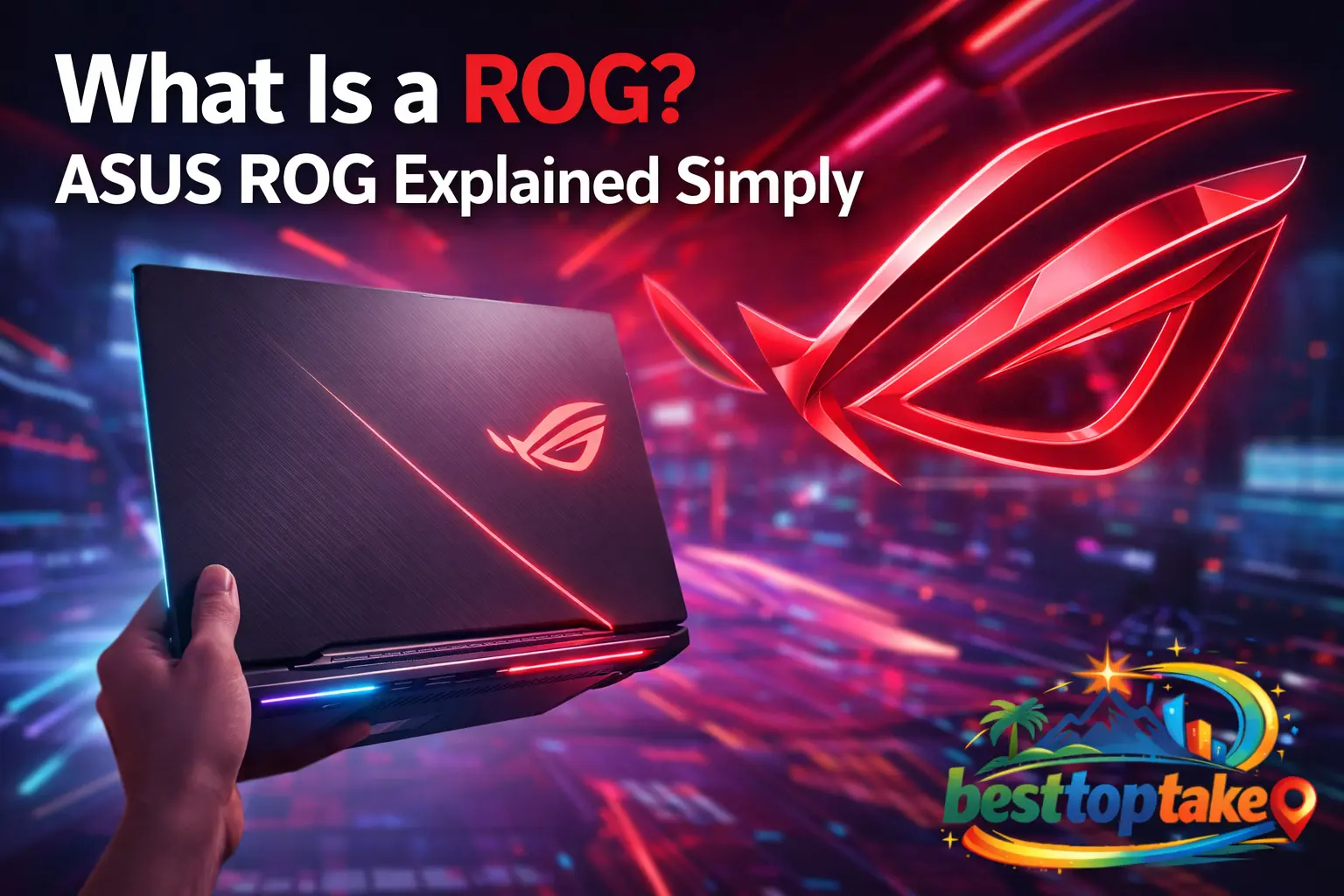
ROG stands for Republic of Gamers, it’s ASUS’s dedicated gaming brand, covering laptops, desktops, monitors, peripherals, and accessories built specifically for high-performance gaming. If you’ve seen the red-and-black logo and wondered what the fuss is about, this article will give you a clear, honest answer.
You’ve Seen the Name Everywhere — But What Does ROG Actually Mean?
You’re shopping for a gaming laptop or a new monitor. You keep seeing “ROG” plastered across products, Reddit threads, and YouTube reviews. Everyone seems to know what it is except you. And rather than ask and feel out of the loop, you just keep scrolling.
I’ve helped a lot of people figure out the gaming PC space, and “what is a ROG?” is one of the most common questions I hear from people who are new to PC gaming or upgrading for the first time. The branding is everywhere, but the explanation is rarely given.
By the end of this article, you’ll know exactly what ROG is, what makes it different, who it’s best for, and whether it’s actually worth spending your money on whether you’re in the US, UK, Canada, or Australia.
3 Common Confusions People Have About ROG
Confusion 1: Thinking ROG Is a Separate Company From ASUS
A lot of people assume ROG is its own standalone brand. They’ll search “ROG laptop” and then be surprised to see ASUS in the product name.
Why it happens: ROG has such a strong visual identity the eye logo, the aggressive styling, the red-and-black aesthetic, that it genuinely feels like a separate entity. ASUS markets it that way on purpose.
The reality: ROG (Republic of Gamers) is a product line owned entirely by ASUS, a Taiwanese tech company founded in 1989. Think of it like how Toyota has the Lexus brand for premium vehicles. ASUS makes mainstream laptops and components; ROG is their premium gaming sub-brand. You’ll find ROG products sold at retailers like Best Buy and Amazon in the US, Currys and Argos in the UK, Canada Computers in Canada, and JB Hi-Fi in Australia.
Confusion 2: Assuming ROG Is Just About Looks
Many people see the RGB lighting, aggressive angular design, and bold branding and assume it’s all style over substance a way to charge more for a flashy case.
Why it happens: Gaming gear has a reputation for being overpriced and gimmicky. Some of that reputation is earned. But ROG sits in a different category.
What you can do: Look past the aesthetics and check the specs. ROG laptops consistently include high-refresh-rate displays (144Hz to 360Hz), top-tier processors (Intel Core i9 or AMD Ryzen 9), and dedicated NVIDIA or AMD graphics cards. The cooling systems are also genuinely engineered the ROG Zephyrus and Strix lines, for example, use custom vapour chamber technology to keep thermals in check during long gaming sessions.
Confusion 3: Believing ROG Is Only for Hardcore Gamers
Because of the branding and price points, people assume ROG products are only for esports professionals or people who game 8 hours a day.
Why it happens: Marketing for gaming gear tends to feature pro players, tournament setups, and over-the-top battle stations. It feels exclusive.
The real picture: ROG has products across a wide range of budgets and use cases. A university student in Melbourne buying their first gaming laptop, a graphic designer in Toronto who wants a high-performance machine for creative work, or a casual gamer in Manchester picking up their first gaming monitor all of these people are legitimate ROG customers. The brand covers everything from entry-level to professional-grade.
The Full Story: What Is a ROG Product Line?
ROG launched in 2006 as ASUS’s answer to the growing demand for dedicated gaming hardware. At the time, most laptops and PCs were built for office productivity gaming on a laptop meant compromising on performance, thermals, and display quality.
ASUS created ROG to change that. The name “Republic of Gamers” was chosen to signal a community identity, not just a product category.
“Gaming hardware has evolved from a niche accessory market to a core computing category. Brands like ROG helped legitimise the idea that performance-first design deserves its own product line.” — Jon Peddie, President of Jon Peddie Research and author of The History of the GPU
Today, ROG covers an enormous range of products. Here’s how they break down:
ROG Laptops
This is where most people start. ROG laptops fall into a few distinct lines:
- ROG Zephyrus — ultra-slim, premium build, designed for portability without sacrificing too much performance. Popular with creative professionals and gamers who travel.
- ROG Strix — the performance-focused line. Bigger, heavier, but with stronger cooling and higher-end GPU options. Aimed at serious gamers who mostly play at a desk.
- ROG Flow — convertible or compact gaming laptops, often with external GPU support. A good pick for people who want flexibility.
- ROG Scar — top-tier esports-focused machines with the highest refresh rate displays and fastest processors available.
ROG Desktops and Components
ROG also makes full desktop gaming PCs (like the ROG Strix G35 tower), motherboards, RAM, graphics cards, and even custom cooling systems. Builders who want a consistent ROG aesthetic across their entire PC often start with a ROG motherboard and build outward.
ROG Monitors
ROG monitors are a standout category. The ROG Swift line is among the most respected in competitive gaming, with models offering 4K resolution, OLED panels, and refresh rates up to 360Hz. For players who care about response time and visual clarity, these are seriously competitive products.
ROG Peripherals
Keyboards, mice, headsets, mousepads, chairs ROG has a full ecosystem. The ROG Chakram mouse, Strix Flare keyboard, and Delta headset are among the more well-known options. These integrate with ASUS’s Armoury Crate software for unified RGB control and performance settings.
How Does ROG Compare to Other Gaming Brands?
ROG isn’t the only name in gaming hardware. Razer, MSI, Alienware (Dell), Lenovo Legion, and Acer Predator all compete in the same space. So how does ROG stack up?
Build quality: ROG consistently receives high marks for build quality, particularly in the Zephyrus line. The use of magnesium alloy and premium materials sets it apart from cheaper plastic-heavy competitors.
Cooling performance: ROG’s thermal engineering is one of its genuine strengths. Independent reviews from outlets like Notebookcheck and Digital Foundry have repeatedly noted that ROG machines handle sustained workloads better than many rivals at the same price point.
Software ecosystem: Armoury Crate, ROG’s companion app, lets you manage fan curves, RGB lighting, performance profiles, and device settings in one place. It’s more capable than some competitors’ software, though it can be resource-heavy on lower-spec machines.
Price: ROG is not cheap. In the US, entry-level ROG laptops start around $900–$1,100. In the UK, comparable entry points sit around £800–£1,000. In Canada and Australia, expect to pay a regional premium on top of that. You are paying for quality — but it’s fair to acknowledge the cost.
“Price-to-performance is the most important metric for gaming hardware buyers. Premium brands like ROG justify their cost through consistent engineering quality, not just brand recognition.” — Linus Sebastian, Founder of Linus Media Group
Is a ROG Product Worth It For You?
This depends entirely on what you need. Here’s a simple way to think about it.
You’ll get great value from ROG if:
- You game regularly (even casually) and want a machine that handles modern titles without stuttering
- You do creative work — video editing, 3D rendering, design — and need high sustained performance
- You want a display with high refresh rate and colour accuracy for either gaming or professional use
- You care about long-term build quality and want something that holds up for 4–5 years
ROG might be overkill if:
- You only play browser-based or low-demand games like Minecraft or older titles
- Your budget is under $700 (US) / £600 (UK) — at that price, the ROG lineup is thin and competing brands offer better value
- You mostly need a general-purpose laptop for work documents and video calls
The ASUS ROG product support and specification database is a useful starting point for comparing models by specs, weight, display type, and GPU tier — directly from the source without relying on retailer listings that can be out of date.
A Real-World Example: Who Actually Buys ROG?
Consider someone like Jamie, a 28-year-old in Brisbane who works in graphic design by day and plays games in the evenings. Jamie needed a laptop that could handle Adobe Premiere, run games like Cyberpunk 2077 at high settings, and not overheat on long sessions. A ROG Zephyrus G14 hit every requirement compact enough for the commute, powerful enough for creative work, and capable of serious gaming.
Or think about Marcus, a 19-year-old in Chicago starting university. He wanted to game competitively and needed a machine for coursework too. His budget was $1,200. A ROG Strix G15 gave him a 144Hz display, an RTX 4060 GPU, and enough RAM to run everything he needed.
These aren’t edge cases — they’re the actual sweet spot for ROG’s audience.
“The convergence of gaming and productivity has made high-performance laptops the default choice for a new generation of buyers who refuse to compromise between work and play.” — Patrick Moorhead, Founder and Chief Analyst at Moor Insights & Strategy
Frequently Asked Questions
Is ROG better than Razer?
Both are premium gaming brands with strong reputations. ROG generally offers better value per dollar on laptops, with stronger cooling and wider product variety. Razer is known for sleeker aesthetics and build quality on specific models like the Blade. Which is better depends on your priorities performance and value tend to favour ROG, while minimalist design may favour Razer.
Are ROG laptops good for everyday use, not just gaming?
Yes. ROG laptops run standard Windows software like any other laptop. The Zephyrus and Flow lines in particular are slim and quiet enough for daily office or study use. The main trade-off is weight and battery life gaming laptops drain faster under load than ultrabooks.
What does the ROG eye logo mean?
The red eye logo is ROG’s brand symbol, representing precision, focus, and competitive performance. It’s become one of the most recognised logos in gaming hardware globally. ASUS uses it across all ROG products to signal they belong to the gaming sub-brand.
Do ROG products work with non-ROG accessories?
Yes. ROG peripherals connect via standard USB or Bluetooth and work with any PC or console. The Armoury Crate software integration is a bonus for ROG users, but it’s not required. A ROG mouse or keyboard works perfectly well with a non-ROG laptop or desktop.
Where can I buy ROG products in the UK and Australia?
In the UK, ROG products are available at Currys, John Lewis, Amazon UK, and specialist gaming retailers like Overclockers and Scan. In Australia, JB Hi-Fi, Harvey Norman, and PB Tech carry a solid range. Online through the official ASUS ROG store is often the best place to find the full catalogue and current pricing.
Wrapping It All Up
Three things to carry with you from this article.
First, ROG is ASUS’s dedicated gaming brand not a separate company, but a premium sub-brand with over 18 years of focused development behind it. The products are real, well-engineered, and widely respected in the industry.
Second, ROG is broader than most people think. It covers laptops, desktops, monitors, peripherals, and components at multiple price points and for a wide range of users, from casual gamers to creative professionals.
Third, whether ROG is worth it depends on your needs and budget. It’s not the right choice for everyone, but for anyone who wants a high-performance machine that handles both gaming and serious work without cutting corners, it’s one of the strongest options available right now.
Now that you know exactly what ROG is, you can shop with confidence and stop scrolling past those red-and-black boxes wondering what you’re missing.

“Electronics aren’t just gadgets. They’re the invisible threads that connect our work, our play, and our world.”
I’m Julian Reed, and my obsession with tech started at age twelve, when I soldered a defunct gaming console back to life in my bedroom. That tiny green screen taught me that technology isn’t just a black box, it’s a tool you can master.
After fifteen years as a hardware engineer and a decade reviewing consumer tech, I’ve joined this team to cut through the jargon. Whether you’re building a high-end home theater or just need a laptop that won’t lag, I’m here to help you choose the gear that truly powers your life.